


As a special treat for this Fourth of July weekend, this second issue of Pizza Lab is doing two things at once: introducing how reviews will work here and actually doing the thing you subscribed for, with a review of Sid’s Pizza Calabrese in Blue Island.
I believe a review should serve both you, my readers, and the pizzerias themselves. A reviewer who will only tell you how awesome everything is does readers a disservice. A reviewer who is uniformly negative just tears families and small businesses down.
I also think that trying to rank pizzas and pizzerias on a rigid scale is a pointless exercise - vagaries of a specific visit, personal preferences, even your mood mean you can never be that accurate.
So I’m not going to try. My reviews should give you a feel for the vibe of the pizzeria, the staff and the owners while going deep into what makes this pizza taste the way it does - the crust, the cheese, the toppings, the bake. I’ll try to break down what I think is contributing to the flavor, or lack thereof, of the slice.
But you do need to know my overall impression as well, so I’m breaking it down into five broad categories:
Needs Work - for some reason, the pizza just doesn’t work. I will lay out the reasons why and offer some suggestions as to how it could improve.
It’ll Do - this is workaday pizza. It’s not special and not really trying to be but it’ll feed you when you’re hungry, is often good value and is the result of hard work. Honestly, most places you ever visit will fall here - and that’s true of any kind of food, service or retail you frequent. Hard working people putting out solid effort.
Neighborhood Gem - we all know this spot. That one place in town that does it right, where you take your guests when they visit. Every town should aspire to have a few Neighborhood Gems and this is what most pizzerias should aim for - to be the best for your community.
Worth the Drive - now we’re cooking with gas (or driving with gas, but no shade if you’ve got an EV because I have one and they’re great). You take your first bite here and your eyes widen a little. This isn’t just good pizza, it’s great pizza. You’ll figure out how to get back here some future weekend even if it’s out of the way because it’s just… that… good.
Destination Pizza - the Pizza Gods have smiled upon you and you’ve entered the Promised Land (actually, the Pizza Gods don’t really promise that much, but it sure is tasty). This is the pizza that makes you question if you really knew what pizza was, if someone had been playing an elaborate hoax on you your whole life and you’d actually been eating something secretly called “puzza.” This isn’t worth just a drive. You plan a whole trip around it.
A caveat, and a huge one - these are my impressions. I’m a quirky guy - can’t eat mushrooms (allergies), I like my bakes as dark as my sense of humor (ok, maybe not that dark, carbon being not that yummy) and I’m not as tied to any particular style of pizza as many folks are. As my friend Paulie Gee says, “No bests, only favorites.”
And with that, I’ve cleared my throat enough. It’s time to take a trip down to southwest suburban Blue Island, the kind of trip that makes you remember just how big Chicago is geographically as it sits on the city border yet it takes an hour to get to from just north of the city.
The Setting
Sid’s Pizza Calabrese is a newer pizzeria opened by Timmy Sids, the nom de pizza of a local Blue Island native, on Olde Western Avenue. It’s in the old downtown, by the tracks and the giant freight train bridge over the Little Calumet River.
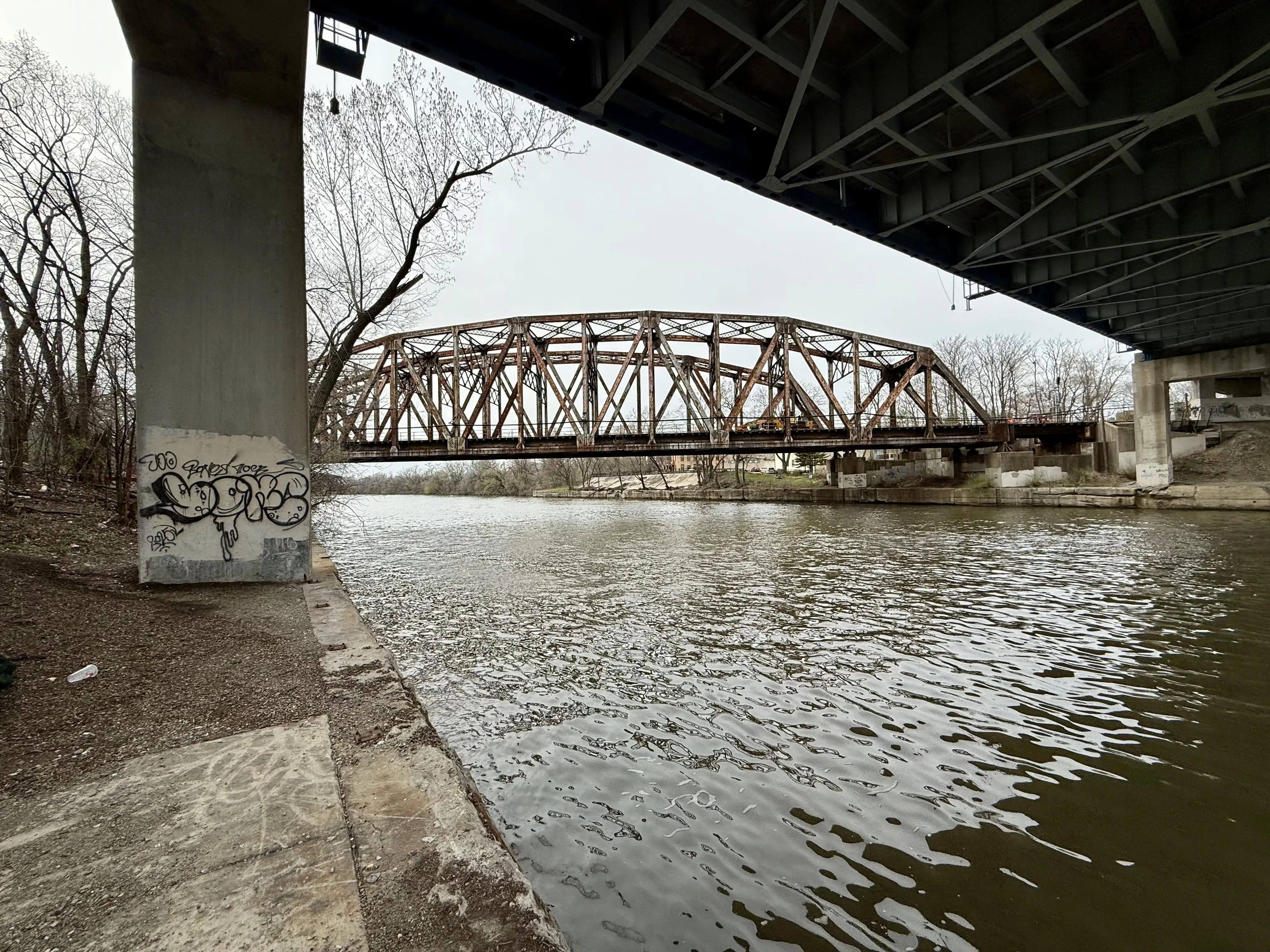
Blue Island is a historic river community (on a National Register, no less) that at one time was the brick capital of Illinois, a working-class town that’s maybe a little down on its luck but working hard to revitalize. You see evidence of this everywhere you walk - beautiful old buildings, fresh new businesses but also more than its fair share of empty storefronts. I stopped at the Blue Island Beer Company (they had some homemade sodas I wanted to try - foreshadowing) and discovered that they would soon be closing for good (and did, in early June). Some sort of dispute with their landlord (the city of Blue Island itself) but that was sort of the feel of the place - struggling but working hard at the same time.


Timmy knows the community well - born and raised, he lives just a few blocks from his new spot, the former Jeben’s Hardware - which operated for over 100 years in the same location - and more recently a cafe. It’s a gorgeous building, made from local brick, with well-worn hardwood floors and a decorative ceiling. As you enter, you first notice how open it is - it still feels more like a coffee shop than a pizzeria. An old wooden dining table mixed among the more standard restaurant tables, a sideboard with a fancy lamp and a couple of deli cases, the checkout and a roped-off area leading to the kitchen in back, where Timmy and his crew work, cranking out as many as 120-140 pizzas a day.
I walked up to order and it seemed like everyone was either family or longtime friends. I got there at a weird time, around 2pm, so they didn’t have every slice available, but I managed to snag two of them - a sausage and a pepperoni.
The Slices
The pizzas at Sid’s are what Timmy calls “Sicilians baked in a Detroit pan” and I would dub “sheet pan pizza”, the kind a grandma from Calabria would teach her grandson to make when he was little.
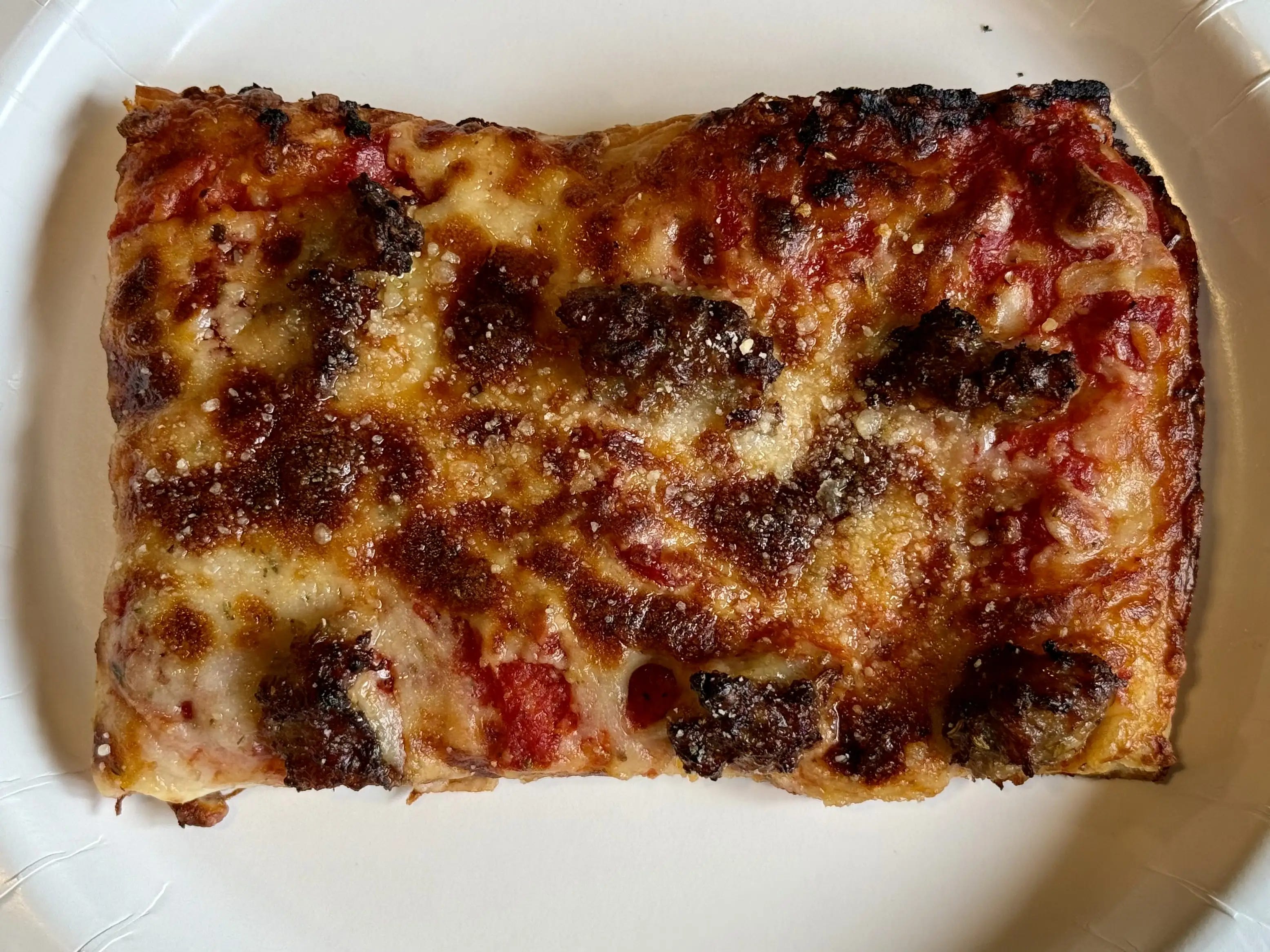


My sausage slice was the stronger of the two slices. Timmy sources his sausage base from Russo but then hand blends in his own set of spices, including copious amounts of whole toasted fennel seeds that he sources from Natural Life Country Store, a small Amish supply shop in Fort Atkinson, WI.
The sausage is really good - I’m a sucker for fennel-forward sausage and Timmy is not being shy here. Placed on top of the cheese so it gets some browning and flavor development, it’s juicy, savory and excellent - I just wish there was more of it. I had eight dime-sized pieces on my 5.5” x 3.5” slice - if they were quarter-sized, I’d have no complaints. And from subsequent photos I’ve seen on social media, it looks like that has been addressed - more and bigger chunks on all the photos I’ve seen.
The dough here is a multi-day process. Timmy uses a blend of Caputo and King Arthur 00 flour and is doing about 70 percent hydration (for every 10 ounces of flour, 7 ounces of water by weight). Because he mixes the dough by hand, he can only make enough dough for 14 pizzas at a time, so he makes up to 10 batches a day. He mixes it into a shaggy mass, does a series of stretch and folds over the course of three hours and ends up with a big glossy ball of dough. By using just a tiny bit of yeast he can then do a long 24-36 hour room-temperature proof.
Once proofed, he takes the dough and presses it into lightly oiled pans, about 20 at a time. At that point, they are topped as orders come in and placed inside a convection oven to bake.
Sidebar: Seriously, what’s up with the convection ovens? Robert Maleski of Milly’s Pizza in the Pan somehow managed to create one of the best pizzas in the world using the worst possible oven for pizza. Convection ovens can’t give you consistent bottom heat, so you have to cook your pizzas a long time or the bottoms come out a little blond. That led Robert to have the goofiest bake I’d ever seen - he would have to bake the pizzas about two-thirds the way and then put the veggies on or they would char due to the lengthy bake time. He has recently become a convert to the wonders of the deck oven and now is fully in love with how much better - and faster - they bake.
Timmy’s slices do come out a little blond - they are still crisp and, unlike a lot of pizzas baked in a pan, not a lick of oil on the bottom. The crust has a finer and denser crumb than a Detroit or traditional Sicilian. When you crack it open, you can definitely detect some yeastiness but it’s subtle. More like the clean smell of fresh white bakery bread than a heavily fermented sourdough. Maybe a little more salt could amplify the fermentation flavors that multi-day proof provides.
Even though Blue Island counts as the South Side, you’ll get no sweet sauce here. Instead, the fresh and bright tasting sauce - made from a blend of Stanislaus 7/11 and Bianco DiNapoli or Ciao DOP tomatoes - is lightly cooked with garlic, onion, olive oil, salt and Italian seasoning. Timmy says sauce should be cooked for less than 20 minutes or more than 4 hours, otherwise the tomatoes turn bitter. His outstanding looking meatball sandwiches get the long cooked sauce. It’s hard to argue with the results.
The mozzarella is Stella low-moisture and is spread across the surface and along the edge to give you a little bit of that frico edge that made Detroit pizza all the rage.
The Story
I talked to Timmy for nearly half an hour as I ate his pizza and discussed pizza making. His mom, a delight who I met working behind the counter, came over from Calabria in the 60s. Italians, he said, don’t do daycare, so he went to his grandparent’s house. It was there that he learned how to garden, how to make bread and focaccia and sheet pan pizza - sauce, tomatoes from the garden, a little bit of parmigiana.
During COVID, like a lot of folks, he started making pizza again. By 2021, he was doing pop-ups on Saturday nights in a local tavern, making 30 pizzas a night. Eventually, pop-ups at Marz Brewing in Bridgeport (home to a number of great pizza pop-ups, including longtime favorites Pizza Fried Chicken Ice Cream/Kim’s Uncle Pizza/Pizz’Amici) and Thursday nights at the cafe in Jeben’s Hardware store. When the cafe closed, Timmy saw his chance to have a home base in his hometown, took over the lease and set up shop. He’s trying to figure out a way to collaborate with other spots in town - Jerry’s, the BBQ joint across the street, and Natural Law with those “a little bit salty” burgers using the seasoned salt that he loves. Maybe do a “food war” where each spot has to come up with a menu item featuring a theme ingredient. Lots of ideas to engage the community. Considering he was selling 120 pizzas a day a few weeks after opening, I’d say he’s tapped into what his community wants.
The Verdict
All in all, a very solid pie. If I lived in Blue Island, this is where I’d get pizza on Friday night. Combined with that story and his obvious love for his community, this spot definitely is a:

Sid’s Pizza Calabrese
13311 Olde Western Ave
Blue Island, IL 60406
(708) 972-7269
Open Thurs-Fri 3-9PM
Sat 12-9PM Sun 12-6PM


As I made my way out from Blue Island, I took a walk along the river, passing by an old school that later became the bottling plant for “The Famous Orange Squeeze,” a local treat created by William Roll in the early 1900s. As has too often become the case, the age of big bottlers and national brands squeezed out “The Famous Orange Squeeze” - it lives on only in memories and antique soda bottles. I might look for one of those old bottles - I love those old regional sodas and their stories, but that is a tale for another day.
Blue Island, like America itself, has changed a lot since its founding. Both have been shaped again and again by the people who came next: Germans and Irish, Italians from Calabria and Mexicans from next door. They weren’t always welcome - they spoke strange languages and ate strange food. But one of those strange new foods, pizza, became as American as the Italians who called this new country home.
Happy Birthday, America. Here’s to 250 more.